
Chapter 23 — Through the Glass
The hospital doors, Bill Allison, the injuries that followed, and the way the meaning of that event changed as later questions were asked.
The Parcel
On 21 March 1962 I went to Yea Hospital carrying clean clothes for Herbie.
Mum had prepared them because the expectation was that he was recovering and would soon be coming home.
The clothes were wrapped in saved brown paper and tied with string.
Nothing like that was casually thrown away in our house.
The brown paper and string had probably come from the weekly meat order from the butcher. String was carefully saved for reuse, just as newspapers were saved and later sold to the butcher for wrapping meat.
It was an ordinary household parcel carried into circumstances which were becoming anything but ordinary.
When I went into Herbie's room he was sitting in a chair.
A nurse was shaving him.
Herbie was an extraordinarily hairy man, and seeing such a large bare area on him looked so strange that I must have shown something in my face.
He laughed.
He told me not to worry.
It would grow back.
That is one of the last ordinary exchanges I remember having with him.
For a moment he was still simply Herbie.
Bill Allison Arrives
Bill Allison came to the hospital.
I remember his presence changing everything.
There are parts of what happened next which I saw directly and other parts which I heard from outside Herbie's room.
I do not want to combine them.
My recollection is that Allison came up behind me and forced me down or backwards in the foyer area.
I remember him taking a chair.
What followed inside Herbie's room I did not see clearly.
I heard Herbie.
I remember him shouting:
“No. No, that's not right.”
There were sounds of a struggle or disturbance.
I remember a nurse running into the room.
I was outside.
That distinction matters.
I can say what I heard.
I cannot honestly turn what I heard into a visual account of what took place inside the room.
Backwards
What happened to me next I remember much more directly.
It was 21 March 1962.
Bill Allison forced me backwards towards the hospital entrance.
I went through the glass doors.
Not through an open doorway.
Through the glass.
I remember the impact.
I remember the glass breaking around me.
I remember ending up outside with pieces of it in and around my head, neck and shoulders.
I was thirteen years old.
For many years I described myself as fourteen when talking about these events.
The calendar now corrects that.
My birthday was near the end of December.
On 21 March 1962 I was thirteen.
The Woman at the Counter
There was a woman at the hospital counter.
I remember her shouting.
I also remember Allison saying words to the effect that she was not to touch me.
Whatever authority he believed he had over the situation, somebody else in that hospital could see that a child had just gone backwards through a glass door.
My memory is that the woman eventually drove me home.
I do not remember being given the sort of medical examination that, looking back as an adult, I would expect after a child had gone through a large sheet of glass.
What I remember instead is going home carrying the glass with me.
Taking the Glass Out
At home, pieces of glass were removed from me.
Mum was involved.
I remember Pam Borrie being there.
There may also have been one of the Henneberry girls.
I am less certain about every person who was present than I am about what they were doing.
They were pulling glass from me.
There were many pieces.
Some were small.
Some were not.
I remember pieces several inches long, some perhaps five or six inches.
They came from around my head, neck, shoulder and upper body.
That scene has always been difficult to reconcile with the absence of any formal response that I can remember.
A policeman had pushed a child through hospital glass.
The child went home.
Women removed the glass.
Then life continued.
What I Did Not Understand
I did not think in terms of assault, compensation, negligence or legal rights.
Those were adult concepts.
I was living inside a much simpler problem.
What would happen next?
Would Allison come after me again?
Was Herbie safe?
Was I in trouble?
Had I somehow caused another disaster?
That was the world available to me.
Many years later people could hear the story and ask questions which seem obvious from an adult perspective.
Why was there no action?
Why was there no claim?
Why was a child not properly treated and protected?
Why was a policeman able to do that?
Those questions did not exist for me in that form in 1962.
The adult who might ordinarily have helped me understand them was Herbie.
He was lying in the hospital.
The Policeman
Bill Allison was not a stranger who appeared once in my childhood.
By then he already occupied a position of fear in my life.
I remember being pulled into the police station, accused, hit and treated as though I was the problem which adults needed to control.
There were broken noses, damaged teeth and other assaults in my memory of those encounters.
I had already learned that the uniform did not necessarily mean safety.
The hospital therefore did not become dangerous only because there was glass in the doorway.
It became dangerous because Bill Allison was there.
That is difficult to express because a hospital and a police officer are two things a child is normally taught to associate with protection.
For me, on that day, they came together in the opposite way.
The Words
There were words from Allison during this period which have remained with me as strongly as some of the physical events.
I remember him shouting at me from the doorway of the police station and expressing the wish that I had suffered the same kind of horrific internal injury which was associated, in the accounts around me, with Herbie's death.
The literal wording is extremely difficult for me to repeat.
I can describe its meaning without forcing myself to reproduce every word.
Sometimes that is the only way I can write about an experience and remain with it long enough to finish the sentence.
The important fact for me is not the exact vocabulary.
It is that an adult policeman was directing that wish at a thirteen-year-old child.
The Next Day
The timing of all of this is now much clearer to me than it was for many years.
The confrontation involving Janette, Des Cameron and Herbie occurred on St Patrick's Day:
Saturday, 17 March 1962.
Four days later, on Wednesday 21 March, I went to the hospital with Herbie's clothes.
That was the day I went backwards through the glass.
Herbie died the following day.
22 March 1962.
The glass incident and Herbie's death were therefore not separated by some long period which later became blurred together in memory.
They were separated by one day.
The Death Certificate
There is another part of the account which came to me through my mother.
Mum said that Dr Patterson refused to sign Herbie's death certificate.
She was also told that he would not agree to her husband, Dr Charles Hosking, signing it.
I was not present for those discussions.
I cannot present them as something I personally witnessed.
They belong to what my mother was told and subsequently told me.
That makes them a different layer of the story.
They became significant because they sat beside the other unresolved questions about what had happened to Herbie between 17 March and his death on 22 March.
If records concerning the death certificate can now be recovered, they may clarify what happened.
Until then, I retain the distinction: this is what my mother told me, not something I personally observed.
Five Days
The sequence can now be placed much more precisely.
Saturday 17 March 1962: Janette broke away from Des Cameron and ran home distressed. Herbie became involved, went across to the presbytery and was injured.
Wednesday 21 March 1962: I went to Yea Hospital carrying Herbie's clean clothes, wrapped in brown paper and string. I saw him sitting in the chair while the nurse shaved him. Bill Allison arrived. Later that day I went backwards through the glass doors.
Thursday 22 March 1962: Herbie died.
For many years I carried a recollection that Herbie had been in hospital for about eight days.
I do not know where that number came from.
Once St Patrick's Day is placed on the calendar and Herbie's date of death is known, the stronger chronology is five days.
That is a useful example of memory and record working together.
The memory gave me St Patrick's Day.
The calendar gives that day a date.
Herbie's recorded death gives the other end of the sequence.
Together they correct something I had carried incorrectly for many years.
The Glass That Did Not End That Night
For many years I believed that not all of the glass had been removed from my body.
There were areas around my head, neck and upper body which continued to trouble me.
Over time I came to associate particular painful or unusual areas with fragments which I believed had remained from the hospital doors.
Some pieces appeared or were encountered later.
Others became part of a much more difficult medical question: whether foreign material remained, where it was, how it should be imaged, and how the findings should be interpreted.
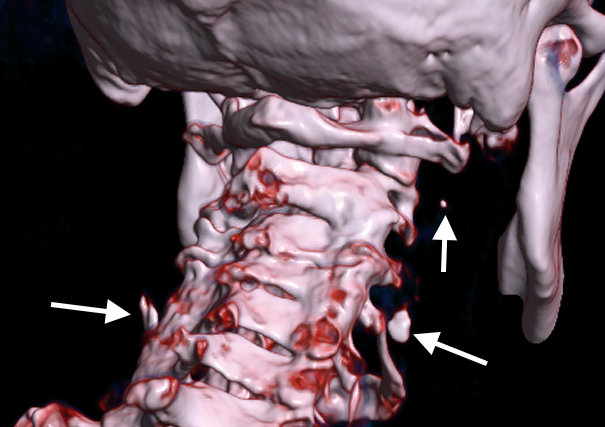
This image comes from a completely different period of my life.
It does not show the hospital door breaking in 1962.
Nor can a three-dimensional reconstruction, by itself, establish that a particular object is a piece of glass from that door.
What it does show is why the physical question did not simply disappear from my life.
There are visible areas which have required investigation and explanation.
The argument over what they are, whether they correspond with retained foreign material and how they should be medically assessed belongs to later chapters and to the medical record.
I do not need to resolve that argument here.
What belongs here is where the question began.
There was a glass door.
I went backwards through it.
People removed pieces of glass from my body afterwards.
And many decades later I was still asking doctors to investigate areas of my head and neck which I believed were connected with that event.
A Body as a Record
Records can disappear.
Accounts can conflict.
Names and dates can be remembered incorrectly.
A police account can differ from a child's account.
A hospital may or may not retain what somebody expects to find sixty years later.
The body can also carry consequences.
That does not mean every later pain proves precisely what caused it.
It does not mean an image should be interpreted beyond what the imaging can actually establish.
But neither does uncertainty make the original event disappear.
For much of my adult life I found myself working backwards from physical questions.
Why does this place hurt?
Why does something feel hard beneath the skin?
Why does a particular movement produce a response?
What happened there?
Again and again, some of those questions led me back to the hospital doors.
Why Didn't Somebody Stop It?
As an adult, one of the hardest questions is not simply why Allison pushed me through the glass.
It is what happened around him.
There were adults.
There was a hospital.
There were people who could see that I was injured.
Somebody shouted.
Somebody drove me home.
My mother and other women removed the glass.
Yet whatever happened afterwards did not result in the kind of protection I would now expect for a thirteen-year-old child.
That is not an accusation against every person who was present.
Somebody did object.
Somebody did help me.
The problem is that individual acts of help did not become a system capable of protecting me from what happened next.
What Happened to the Story
As with so much else in my childhood, there were really two events.
There was what happened.
Then there was what happened to the story afterwards.
The first involved a hospital, a policeman and shattered glass.
The second involved silence, interpretation, authority and the absence of the response which an adult looking back might expect.
For a thirteen-year-old child there was no investigation to manage, no lawyer to instruct and no carefully preserved evidence file.
There was simply the next day.
And on the next day Herbie died.
Through the Glass
For a long time I treated the glass almost as another incident in a childhood full of incidents.
Only much later did I begin to understand how extraordinary it was.
On 21 March 1962, a thirteen-year-old child went backwards through the glass doors of a hospital.
He went home.
People pulled glass from his body.
The next day the man he regarded as his safest adult was dead.
The policeman remained the policeman.
The child remained the problem.
When I look back now, the broken door is not the strangest part.
The strangest part is how quickly people can be required to continue after something which should have stopped everything.
The door broke once.
For me, the glass continued much longer.
